https://www.thefp.com/p/the-filmmaker-ai-hollywood
h/t to https://x.com/shellenberger/status/2056086419693777078?s=20


The Filmmaker Using AI to Beat Hollywood

Two days after U.S. special forces rescued an American pilot from Iran, an AI-generated Lego film recreating the entire mission was already racking up millions of views on X. Filmmaker Charlie Curran made it in 30 minutes. Pirate Wires’ Ryan Hassan sat down with him to talk about how he’s building a full AI film studio in LA, why the Marvelfication of Hollywood was always going to crack the system open, and what comes next. We’re republishing it in our pages today, but for some of the sharpest writing on all things tech, be sure to follow the work of our colleagues over at Pirate Wires.

Two days after U.S. special forces rescued an American soldier from the depths of the Iranian mountains, an AI-generated film went viral on X. At just over a minute long, it recreates the entire saga of DUDE-44 (the call sign of the fallen jet). . . with Lego soldiers, fighter jet explosions, and a (again, Lego) POTUS feature. Bricky helicopters fly through Iranian mountains while soldiers on the ground try to survive plastic shoot-outs.
Title: Rescuing American Pilot in Iran (2026, colorized)

The post exploded (sorry), collecting millions of views.
“Hollywood will not be able to keep up with this,” one viewer wrote. “It just happen [sic] 2 days ago and there’s already a short movie.”
“We deserve a full length feature!!” someone else replied.
“I don’t care what your political stance is, God Bless Our Troops and God Bless America,” said one patriot.
This instant classic is the work of Charlie Curran, a filmmaker testing the limits of the form with the help of AI. He started posting short films on X in January and has made a name for himself since then, generating tens of millions of views (and $27K from X payouts in just 2 weeks). He’s even drawn attention from Elon Musk. . . in response to an AI-generated horror film he created titled Titty Killer 5.
This isn’t “slop.” That label’s been commodified. The word doesn’t really mean anything anymore—most videos created today use AI to some extent. Curran is a professional producing short films enabled and accelerated by AI.

The short films Curran cooks up are reminiscent of 2010s edits of Thanos snapping or Hitler raging at getting banned on Xbox Live. Back then, posters cut together existing footage, dubbing voices or adding fake subtitles to comment on the culture for a captive audience. AI speeds this up.
Thanks to tools like Seedance 2.0 (Chinese tech giant ByteDance’s newest AI model), Curran can react to breaking news almost immediately. Unlike American models, Seedance nails character consistency—meaning, for the first time, AI-generated people don’t look uncanny and weird.
During the Anthropic-Pentagon spat in February, right after Anthropic missed Defense Secretary Pete Hegseth’s deadline to agree to the Pentagon’s terms, Curran posted a video of President Donald Trump putting Secretary of State Marco Rubio in charge of the AI giant. Rubio roams a data center in a hoodie and eats a chopped salad in the shadow of the Golden Gate Bridge. The video reached over three million people and was called, by some, “the funniest piece of AI-generated video” they’d ever seen. Curran tells me he created it in a few hours.
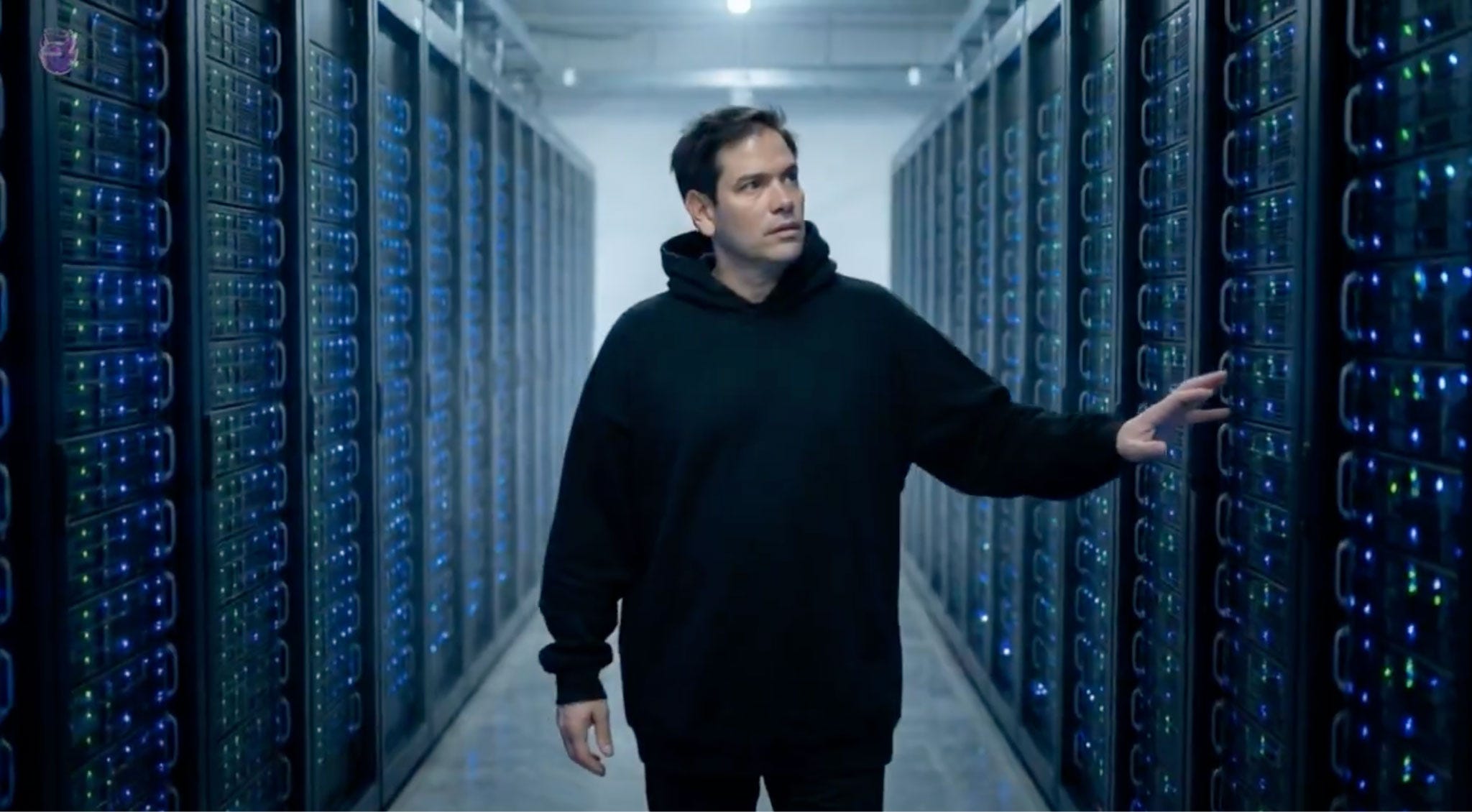
It always starts with a funny idea, he says.
“If there’s ever an idea that I have and I don’t do it right away and I wake up the next morning like, wait, I have to do this, I know it’s going to go viral.”
That’s the part AI can’t replace.
Take one of Curran’s most viral videos: The Rizzler entering World War III.
“I knew exactly what I wanted,” he tells me. “I wanted Rizzler launching and then an F-35 launching off a hardtop somewhere in the Mediterranean. I knew I wanted him to be doing a bombing run. I knew I wanted him to take some evasive maneuvers to avoid a missile. And then I wanted some girl in the street to thank him.”
Even if this video could have existed in a world without AI, it certainly wouldn’t have been as quick or inexpensive to make. Curran posted it on March 1, 2026, just one day after the U.S. launched a broad range of strikes on Iran; it currently has 9.8 million views.
He made it in 30 minutes.

Hollywood’s been going insane over AI for the past three years, starting back when the tech was barely capable of generating Will Smith eating spaghetti. Media labor union SAG-AFTRA went on strike for over 100 days in 2023, and contract negotiations are stalled again; the union’s pushing to make synthetic performers “as expensive as humans” and floating ideas like a “Tilly tax” on AI-generated characters (it’s named after Tilly Norwood, an AI-generated “actress”). James Cameron, no Luddite by any stretch of the imagination, called AI-generated performances “horrifying.” Luca Guadagnino (of Call Me by Your Name fame) said AI actors mark “the end of the industry as we know it.”
“[AI] is how you get an artistic revolution. Young voices making new kinds of stories that weren’t financially viable in the studio system.” —Charlie Curran
But Curran isn’t horrified. He’s excited.
And, unlike the “slop artists” Hollywood fearmongers envision taking their jobs, he’s devoted to the craft.
“I’m a really ferocious film watcher,” Curran says. “I watch over 300, sometimes 400 films a year. I have a film school background and I love cinema. I just genuinely do.”
He’s made movies for 20 years. After film school at the Savannah College of Art and Design, Curran worked in commercial filmmaking, producing movies for Nike, Google, and the World Economic Forum. He released a feature film, See Know Evil, in 2018.
“The people who are the best at storytelling should be the ones with the best tools to tell their story,” he says—not the people who happen to live in LA and know the right people. It’s ironic that Hollywood—supposedly home to culture’s visionaries—struggles to accept AI’s white pill, as Curran sees it.
“If you look at someone like Jia Zhangke in China, who’s an incredible filmmaker, probably one of the most important of the 21st century, he has no qualms about [AI filmmaking],” Curran explains. “He just kind of says, ‘Cinema’s always been a technology-driven art. . . ’ ”
Curran concedes that AI video isn’t perfect. “It’s just very difficult to keep consistent characters, environments, and geometry without it changing shot to shot.” But the models are improving; these are solvable problems.
Ultimately, he’s bracing for a cultural revolution like “the ’70s,” he says. After the introduction of a ratings system in 1968 (G, M for Mature, R, and X), studios were free to make films that featured sex, violence, and adult content. . . which they hadn’t under Hollywood’s strict one-size-fits-all censorship codes. This unlocked a new era of weird, wild, shocking filmmaking: “New Hollywood.” The collapse of the studio system in the late ’40s accelerated the trend, and so did new technology, like lightweight cameras directors could use to shoot on the street.
Curran believes AI will unlock the next New Hollywood.
“[AI] is how you get an artistic revolution,” he says. “Young voices making new kinds of stories that weren’t financially viable in the studio system.”

Early this year, Charlie founded Menace Studio in LA to scale his vision for AI-generated film. He has four people on staff, and they’re already printing.
“We’ve signed a number of larger brands that people probably know of” to buy AI films, he says.
Who wants to work with an AI creative agency? “Turns out it’s everybody,” Curran says. “We’ve been talking to CMOs at ad agencies, we’ve been talking to content creators, we’ve been talking to celebrities and their teams. . . there’s infinity demand.”
But advertising is just the first step. Curran has dreams of total creative freedom.
“The crisis of Hollywood is the Marvelfication of this slop. . . the bigger the capital costs, the less risks you can take.” For Curran, “the end goal is we’re going to have a movie studio and we’re going to be able to self-distribute. That’s the Roger Corman dream, and I think that’s what AI allows.” (Corman is the Hollywood legend who launched the careers of Martin Scorsese, James Cameron, and Francis Ford Coppola in the ’60s and ’70s.)
Threats to Hollywood predate AI, of course. American and Canadian theaters sold 1.6 billion tickets in 2002, and a little under 800 million in 2025. Consolidation, corporatization, and risk-hedging have been happening since the ’80s, crystallizing in what many see as the “Marvelfication” of the theatrical experience: an unrelenting stream of films you think you’ve seen before, reheating the leftovers of 20th century IP.
AI could, according to Curran, be the remedy to some of this. He calls it “the ‘Sputnik moment’ for Hollywood”—the shock we need to actually make great movies again.
Last time the Hollywood studio system cracked open like this, we got George Lucas. If Star Wars is slop now, maybe we need a young-gun director to do something that finally feels new?
Mostly, we need someone who is not scared of technology. After all, like Curran says, “it’s just going to come down to taste, curation, and distribution like it always has.”


No comments:
Post a Comment